The Two Elijahs...
One of the first websites I had launched as a protest to an injustice which occurred in August 2019 regarding the tragic death of Elijah McClain. His mother took issue with my website, and explained to me that there was absolutely no way I could ever understand anything about what had happened to him. That was very prejudicial of her, but I attributed her attitude towards me to misunderstanding. It was wrong of her (not only in my opinion, but actually wrong of her) to not acknowledge my reasoning for my article since I advocate for people who are often misjudged, or stereotyped. I know of men who were told by people in the human services field to not have facial hair at all so to not be stigmatized as vagrants by police or vigilante types. What really caused me to launch the website was when the coroner remarked on the autopsy report that Elijah had “possible undiagnosed mental illness” which was a way to scapegoat him. The fact that no one ever specifically addressed that stigma and what it really meant, that the attack against him was justifiable since he was “mentally ill”, was what I took issue with. People in the demographic are disproportionately victimized by vigilantism violence because of bias.
In my defense, I actually did point out a couple things that other people weren't mentioning about the incident. One was that even though it was August, it was late in the month and it wasn't very warm that evening. I checked the weather history. I'm a bit indignant about that since in the social media discussions there were a number of people criticizing Elijah for wearing his face-mask in the summertime.
I had also walked up that very street and could see another reason why he'd be a bit picky about walking through there in the evenings, wanting to protect his face. I had already known that people who always drive everywhere they go might not take into consideration the various hazards (maybe strong word here for this case) a pedestrian might encounter. Many people don't care, or else they figure it's all just the world as it is, that's why they drive, which is fine but yet there are those who figure it's their position to judge others who get around on foot.
Anyway, the area where Elijah lived was right next to a freeway and there is an on-ramp to it just down the street from where he lived. There could be times when wind-eddies and dust could be bad in the area. The other thing is that on the side of his street that was parallel to the freeway there was no sidewalk, and towards the corner the shoulder area of the street was a washed out depression so impassable in a practical sense. On the side of the street that had a walkway there was a six-foot fence along it with over-hanging branches from a tree on the other side. There was a panel-van type vehicle parked alongside there when I walked up the street and so the result is a narrow path between the vehicle and fence with possible spider webs from the tree branches.
The other thing I pointed out about Elijah wearing the mask is that he may have had a problem with Pseudofolliculitis barbae (razor bumps) and if he used ointment on his face then he might’ve like to wear the mask outside because of that. I would get into the social media discussions about what happened to him and I’d point out that police are supposed to have enough general knowledge about people to be aware of personal quirks someone might have. (I also pointed out that in the police video of him it is rather obvious he was carrying a bag of large cans. A white plastic bag, even.)
My involvement may have seem inconsequential and moot to his mother but it’s quite possible that I made a difference.
I wanted to re-publish the article I wrote because of the aforementioned reasons and this seems like a good place.
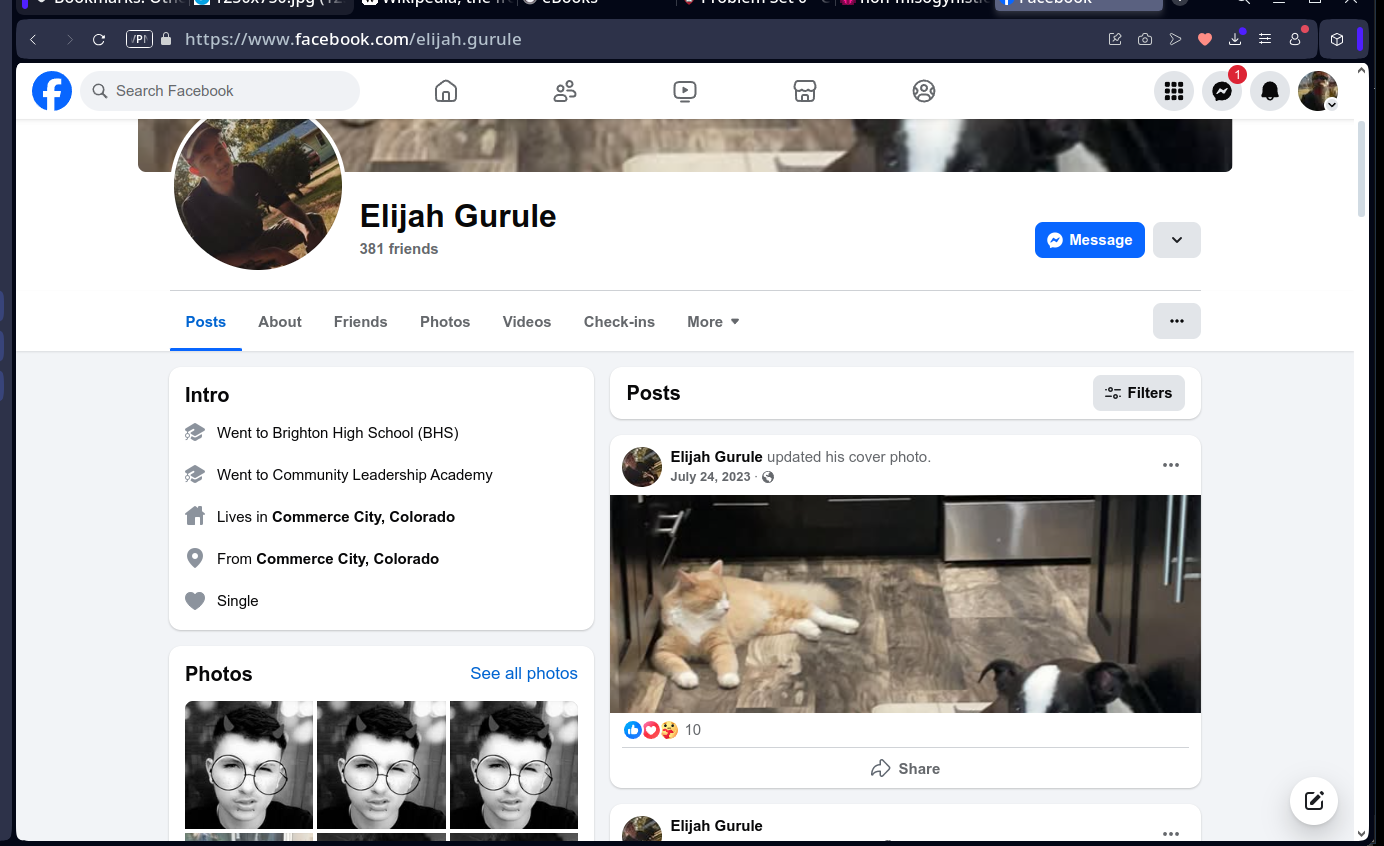
The other Elijah is an assistant property manager I knew who was working for Syringa Property Management. I’m not going into the entire story here but let it suffice to mention that he quit his job, moved out of his apartment and vanished. Might seem conspiracy theoretical of me, could be lots of explanations for what I see as evidence. Maybe he just doesn’t want me snooping so had to take pains to avoid me (some may insist). The real odd thing is though that I never contacted him through his Facebook profile after I found him, and I used an alias account to access his page, so he wouldn’t have known that I found him.
What is so concerning is that his cover photograph is of his pet dog & cat that was taken in the kitchen of his old apartment that he moved out of two years ago. I know he moved out since I moved to his complex a month after he left. I moved to the complex to prove to him that I could, actually. I know he quit his job at the property management business because the lead manager had issued a (rambling) newsletter where she included that he no longer worked there. She didn’t indicate that he had been transferred to another property, in fact she expressed it as “she had to hire a temporary replacement until the position can be filled”.
The additional reasoning is that my inclusion of Elijah Gurule is evidence of the extraordinary turn over of employees that work for the multi-unit residential property companies. The argument could be made that I must be imagining it, or whatever, the people don’t have to always be in same leasing office so they probably didn’t just quit, but there’s also some odd circumstantial evidence to what I allege. I continue to get texts from a lady every month for reminder that rent is due by the ninth but she doesn’t work here anymore. The “due by the ninth” part has since been overridden by a new manager via an email that followed the landlady’s introduction email.
There’s even more to all of that but it’s a separate issue.
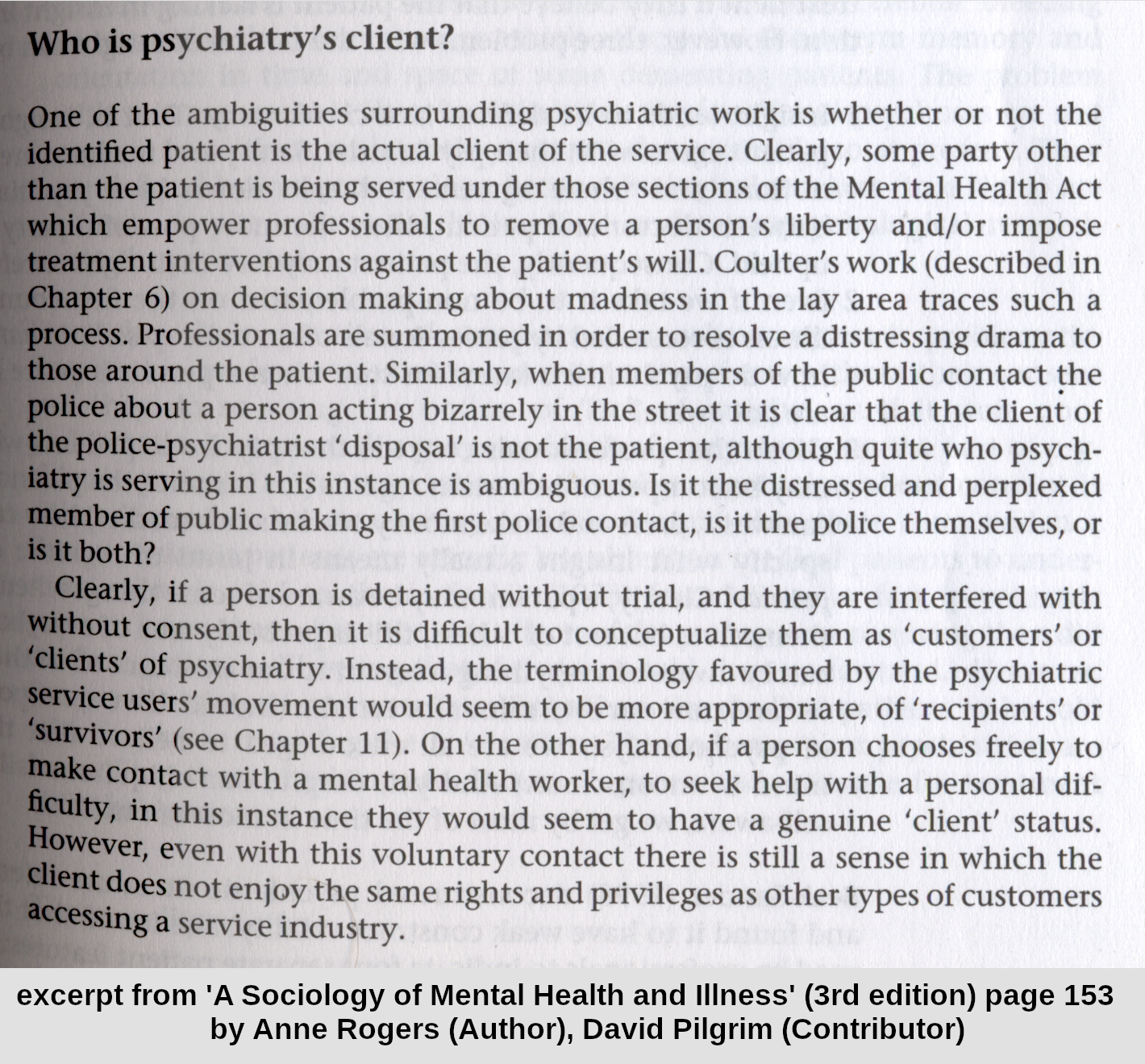
excerpt from "A Sociology of Mental Health and Illness" (3rd edition) page 153
by Anne Rogers (Author), David Pilgrim (Contributor)
Who is psychiatry's client?
One of the ambiguities surrounding psychiatric work is whether or not the identified patient is the actual client of the service. Clearly, some party other than the patient is being served under those sections of the Mental Health Act which empower professionals to remove a person's liberty and/or impose treatment interventions against the patient's will. Coulter's work (described in Chapter 6) on decision making about madness in the lay area traces such a process. Professionals are summoned in order to resolve a distressing drama to those around the patient. Similarly, when members of the public contact the police about a person acting bizarrely in the street it is clear that the client of the police-psychiatrist "disposal" is not the patient, although quite who psychiatry is serving in this instance is ambiguous. Is it the distressed and perplexed member of public making the first police contact, is it the police themselves, or is it both?
Clearly, if a person is detained without trial, and they are interfered with without consent, then it is difficult to conceptualize them as "customers" or "clients" of psychiatry. Instead, the terminology favoured by the psychiatric service users' movement would seem to be more appropriate, of "recipients" or "survivors" (see Chapter 11). On the other hand, if a person chooses freely to make contact with a mental health worker, to seek help with a personal difficulty, in this instance they would seem to have a genuine "client" status.
However, even with this voluntary contact there is still a sense in which the client does not enjoy the same rights and privileges as other types of customers accessing a service industry.
Copyright (C) Anne Rogers and David Pilgrim 2005
"A Sociology of Mental Health and Illness" (3rd edition)
ISBN 10: 0335215831 / ISBN 13: 9780335215836
Professor Anne E Rogers SRN, BSc (Hons),
MSc (Econ) Sociology Applied to Medicine,
PHD (Sociology & Social Policy);
Fellow of the Academy of Social Sciences,
Emeritus NIHR Senior Investigator
A Sociology of Mental Health and Illness (5th revised edition)